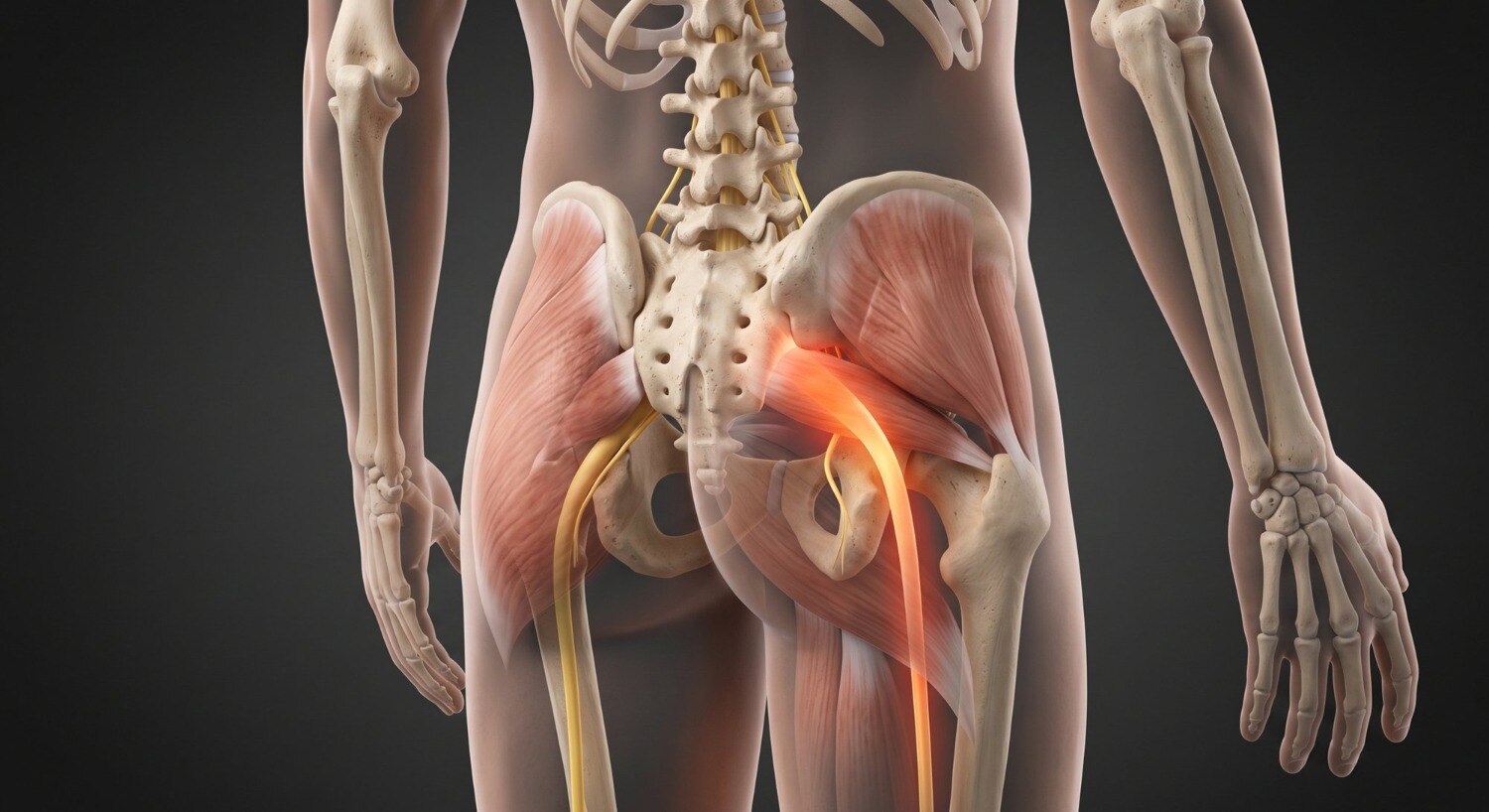
Back pain after a tackle, fall, lift, sprint, jump or sudden twist needs more than a machine-based treatment choice. You will learn how to screen for urgent symptoms, what a proper assessment should cover, how active rehabilitation progresses, and which return-to-sport milestones show that your back is ready for load.
Key takeaways
- Seek emergency care for bladder or bowel loss, saddle numbness, or progressive leg weakness.
- Choose assessment-led treatment that checks movement, strength, nerves, and sport-specific demands.
- Build back capacity with graded exercise instead of relying on passive pain relief alone.
- Return to sport when strength, movement, and sport drills meet clear progress markers.
When Back Pain After a Sports Injury Needs Urgent Medical Care
Do not book routine physiotherapy if back pain after a sports injury comes with new bladder or bowel loss, numbness around the genitals or inner thighs, progressive leg weakness, or severe pain down both legs. These symptoms can indicate cauda equina compression and need emergency assessment.
Seek same-day medical review after a high-impact collision or fall if you cannot bear weight, suspect a fracture, develop fever, experience persistent night pain, or have worsening numbness, altered reflexes, or weakness.
Adolescent athletes with focal pain during spinal extension, especially after repeated extension and rotation, need review for a pars interarticularis stress injury rather than repeated treatment for a presumed muscle strain.
| Situation | What to do | Why it matters |
|---|---|---|
| Emergency symptoms | Go to an emergency department now | Nerve compression or serious injury needs rapid assessment |
| Concerning but stable symptoms | Arrange same-day physician or urgent-care review | Examination and a decision about X-ray or MRI may be needed |
| Local pain without red flags | Book a clinical physiotherapy assessment | Rehabilitation can begin after screening |
A clinician may reassess neurological signs during recovery. Do not increase exercises if objective weakness is worsening. Routine MRI or X-ray is not recommended for uncomplicated low-back pain; imaging is used when serious disease is suspected or results will change management.
If you searched “sports injury back pain physiotherapy in pune”, choose assessment before a machine or treatment brand.
What a Physiotherapist Must Assess Before Choosing Treatment
The first appointment should build a clinical picture before selecting exercises, equipment or manual treatment. The physiotherapist records how the injury happened, where pain sits, whether it travels into a leg, previous injuries, training load, and the movements your sport demands.
The assessment should include:
- Spinal movement, hip movement, walking, balance, strength, sensation and reflexes
- Pain response during controlled movements, including extension and rotation
- Coughing or straining symptoms, sleep disruption, and changes in training tolerance
- Screening for fracture, neurological compromise and vertebral stress injury
A clinician compares findings rather than asking you to label the problem yourself.
| Possible source | Findings that guide clinical reasoning | Action if suspected |
|---|---|---|
| Muscle strain | Local pain after a sudden overload, with pain on resisted movement | Begin graded loading if serious injury is excluded |
| Disc-related pain | Back pain with leg symptoms, altered sensation or weakness | Complete neurological testing and consider medical review |
| Facet or other spinal joint | Localised pain linked to extension or rotation | Match treatment to movement tolerance |
| Sacroiliac region | Pain near one side of the pelvis, reproduced by a cluster of tests | Avoid relying on one tender spot as proof |
| Pars stress injury | Focal pain with extension, especially in a young athlete | Stop aggravating loading and arrange medical review |
| Hip source | Restricted or painful hip movement, groin pain, or reduced single-leg control | Assess the hip and refer for imaging when indicated |
These patterns overlap, so a label from an online symptom search is unreliable. Persistent focal pain, night pain, neurological changes, high-impact trauma, or failure to improve needs physician review; X-ray or MRI is chosen when the result will change management. For back injury physiotherapy vishrantwadi, choose assessment-led care rather than a machine-led package.
What Active Rehabilitation Looks Like After a Sports Back Injury
Recovery should begin with a clinical assessment, then move through graded loading rather than prolonged bed rest. The best physiotherapy for back pain in Vishrantwadi should match exercises to your symptoms, examination findings, training load and sport demands.
A progressive programme can include:
- Trunk strength and endurance, such as controlled bracing, carries and hip-hinge work.
- Movement-control exercises for bending, rotation, landing and lifting.
- Walking or other aerobic exercise to restore capacity without provoking a flare-up.
- Sport-specific strength, running, jumping and skill drills added in stages.
- A review date with measurable targets, such as pain-free walking, lifting or practice.
| Option | Benefit | Limitation |
|---|---|---|
| Complete rest | Reduces activity briefly during a highly irritable phase | Prolonged rest lowers strength and makes return harder |
| Medication | Can reduce pain enough to move and exercise | Does not restore strength, control or sport tolerance |
| Massage alone | May ease muscle tightness temporarily | Does not provide progressive loading |
| Manipulation | May help selected cases for short-term relief | It cannot replace exercise or load management |
| Injection | Has a role after medical assessment for specific conditions | It is not a general solution for sports back pain |
| Immediate training | Preserves routine only when fully tolerated | Returning before capacity returns can trigger recurrence |
Heat, ice or hands-on treatment can support comfort, but TENS, ultrasound and traction should not replace active rehabilitation. Progression should follow response over the next day, not pain relief during one session alone.
How to Measure Progress and Return to Sport Safely
Progress is shown by what your back tolerates, not by days since the injury or pain while lying still. Use repeatable tests, symptom response over the next 24 hours, movement quality, strength, and confidence to decide whether to increase load.
| Stage | Measurable signs | Advance when |
|---|---|---|
| Daily activity | Walk, sit, climb stairs and dress without altered movement or escalating leg symptoms | Symptoms remain stable during activity and settle to your usual baseline by the next morning |
| Running | Brisk walking, jogging, acceleration and stopping are pain-controlled, with no limp or protective trunk movement | Complete repeated running bouts without a meaningful flare during the next 24 hours |
| Strength training | Perform prescribed squats, hinges, lunges, carries and trunk exercises with controlled technique and near-symmetrical strength | Increase resistance or repetitions without loss of form or next-day deterioration |
| Practice | Complete cutting, jumping, sprinting, contact or sport-specific drills at increasing intensity | Tolerate a full practice at near-normal intensity and recover normally afterward |
| Competition | Match-duration effort produces no neurological symptoms, disabling pain or movement compensation | Compete only after practice loads are tolerated and confidence matches the required intensity |
Increase one variable at a time: volume, intensity, range, frequency or speed. A sudden rise in sprinting, lifting, bowling or match volume can revive symptoms even as tissue healing continues.
Ask whether your athlete back pain treatment in Pune includes these milestones and a review date. Sports injury back pain physiotherapy in Pune should test your sport’s demands rather than clear you because resting pain has reduced.
How to Compare Back-Injury Physiotherapy Services in Vishrantwadi
Ask for a criteria-based plan, not a menu of machines. The best physiotherapy for back pain in Vishrantwadi should begin with an assessment of how the injury happened, leg symptoms, neurological findings, hip and spinal movement, current training load, and the demands of your sport.
Ask the clinic these questions:
- What milestones will you measure for walking, lifting, running, jumping and sport drills?
- When is the first review, and what finding will change the exercise plan?
- How will you increase repetitions, resistance, speed or training volume without provoking a flare-up?
- What sport-specific tests will support return to practice and competition?
- If pain persists, worsens at night, follows high-impact trauma or suggests a stress injury, who will arrange medical review?
| Question to compare | Strong answer | Warning sign |
|---|---|---|
| Treatment focus | Trunk endurance, movement control, aerobic work and progressive strengthening | Passive machines form the whole plan |
| Progression | Written milestones and planned load increases | “Continue until it feels better” |
| Return to sport | Running, jumping, changing direction and sport drills are tested | Clearance depends only on time or resting pain |
| Review | A dated reassessment checks strength, movement and symptoms | No review point is scheduled |
A back injury physiotherapy Vishrantwadi service should also explain why it uses or avoids ultrasound, TENS or traction, rather than presenting them as the defining treatment. Dr Renukas Physiotherapy center is worth comparing by these clinical questions, not by equipment or branding.
Frequently asked questions
When does back pain after a sports injury need urgent medical care?
Seek emergency assessment for new bladder or bowel loss, numbness around the genitals or inner thighs, progressive leg weakness, or severe pain down both legs. These symptoms can indicate cauda equina compression.
What should a physiotherapist assess before treating sports-related back pain?
The assessment should cover the injury mechanism, pain behaviour, spinal movement, hip and leg strength, sensation, reflexes, nerve tension, training load, and sport-specific movements.
What does active rehabilitation involve after a sports back injury?
Rehabilitation progresses from pain-controlled movement and trunk endurance to strength, running, jumping, rotation, lifting, and sport-specific drills. The programme should increase load in measured stages.
How can you compare back-injury physiotherapy services in Vishrantwadi?
Ask whether the clinic performs a documented assessment, explains the diagnosis and plan, uses progressive exercise, tracks measurable outcomes, and provides clear criteria for returning to training and competition.
Keywords